sexta-feira, 25 de outubro de 2024

Argos’s Risk Scores: Scientific Accountability or Author Shaming?


Following up on the previous post about a study from the University of Bern tracking errors in academic papers (linked above), it's worth highlighting a recent article in Nature that offers an in-depth look at Argos, a newly launched science-integrity platform. Argos aims to identify potentially problematic research papers by assigning risk scores based on factors such as the authors' publication history and the extent to which the work cites previously retracted studies.  https://www.nature.com/articles/d41586-024-03427-w  

However, Argos raises several concerns despite its intention to flag high-risk papers. A high-risk score does not automatically indicate that a paper is of poor quality or fraudulent. Its heavy reliance on retraction history can result in false positives, potentially penalizing authors for past associations rather than reflecting the actual quality of their current work. Furthermore, the use of open data sources, such as Retraction Watch, increases the risk of misidentifications, particularly with common author names. Labeling papers as high-risk without thorough investigation may lead to misguided actions. Additionally, Argos's commercial interests could present a conflict of interest, fostering excessive retractions to protect reputations rather than ensuring genuine integrity.

Declaration of Competing Interests - In 2019, I authored a critique of Retraction Watch in a post entitled 'Public Shaming in Academia or Sharia Law in Academia?'  https://pacheco-torgal.blogspot.com/2019/10/public-shaming-in-academia.html

quarta-feira, 23 de outubro de 2024

Reconhecer o mérito a quem o merece: Pódio da UPorto, ULisboa, UNova e UMinho

 https://19-pacheco-torgal-19.blogspot.com/2024/10/ubi-dar-merito-quem-realmente-o-merece.html

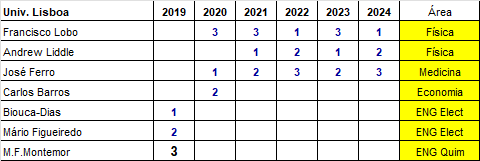
Na sequência do post supra, sobre os investigadores da UBI, melhor classificados no ranking Stanford-Elsevier entre 2019 e 2024, reproduzo abaixo o nome dos investigadores que integraram o pódio nas universidades do Porto, de Lisboa, da U.Nova e da U.Minho.


German-Swiss study shows that 2 million European homes could abandon the grid


Following up on my previous post, available at the link above, where I discussed an interesting article by two researchers from the University of Cambridge,  I would like to highlight another study conducted by researchers from universities in Germany and Switzerland. This study investigates the potential for energy self-sufficiency in 41 million homes across Europe and concludes that 53% of these homes could achieve this using photovoltaic panels and battery storage systems. Furthermore, the article estimates that by 2050, approximately 2 million homes could fully disconnect from the electrical grid. https://www.sciencedirect.com/science/article/abs/pii/S2542435123004026

Paradoxically, these scenarios may not be as ambitious as they initially appear. A home that disconnects from the grid and becomes energy self-sufficient does not necessarily yield substantial benefits, particularly when considering not only the financial costs but, more critically, the urgent need for the decarbonization of the building sector. Decarbonization extends beyond energy production to include the materials used in construction—an essential factor that is often neglected. Unfortunately, this oversight is shared by several individuals, even those with significant academic credentials, as I have previously critiqued https://19-pacheco-torgal-19.blogspot.com/2024/03/addressing-euronews-oversight-essential.html

PS - It is essential to emphasize that the recent Draghi report highlights decarbonization as a pivotal element in bolstering EU competitiveness https://19-pacheco-torgal-19.blogspot.com/2024/09/recalling-my-past-clash-with-german-mp.html